
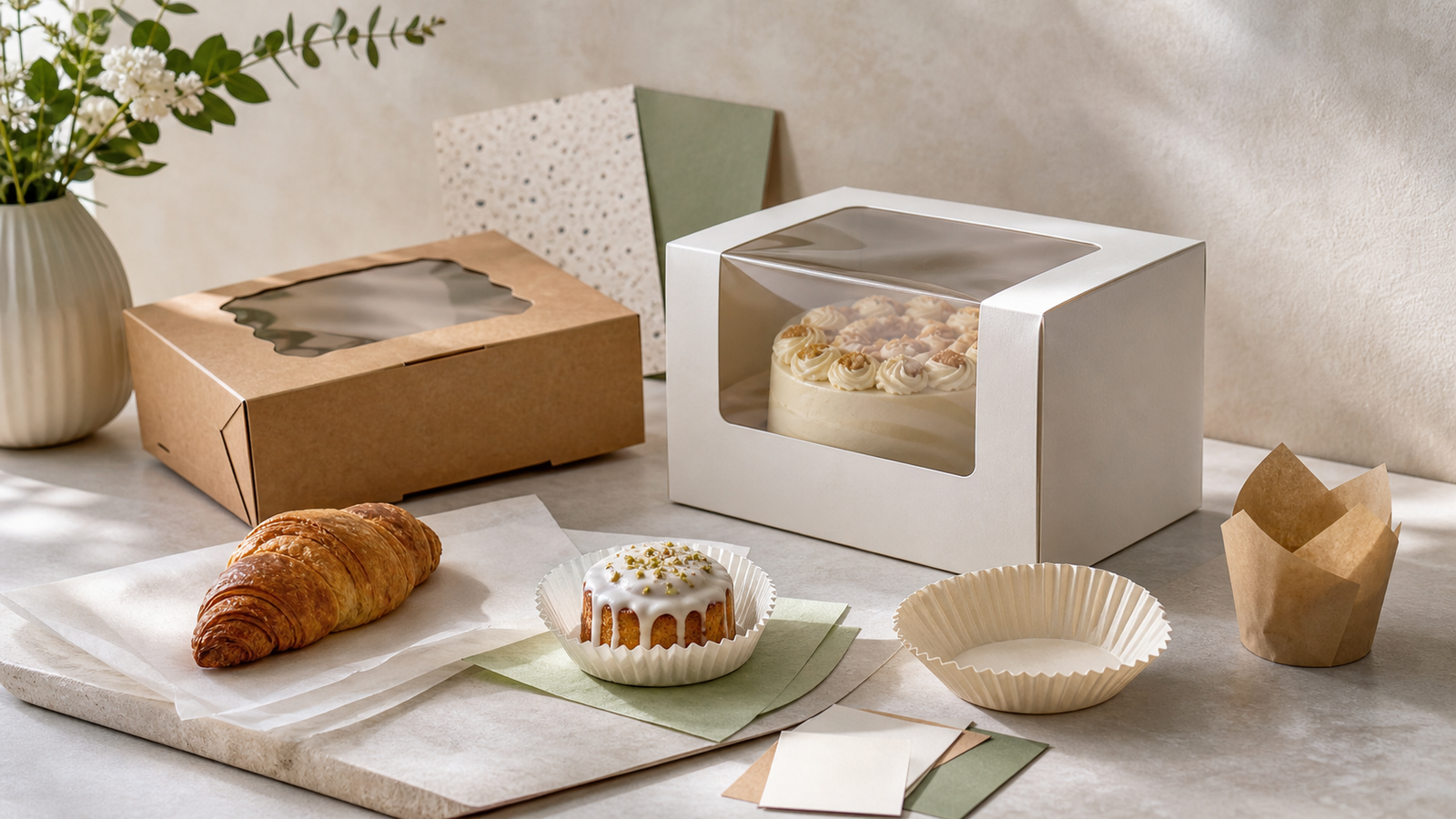
Food-safe bakery packaging must do more than look attractive. It needs to protect texture, prevent grease marks, support safe handling, survive transport and present the product clearly at the point of sale. The best box is therefore not simply the thickest or most expensive option. It is the structure and material combination that matches the food, selling environment and delivery route.
This guide gives bakery owners, food brands and packaging buyers a practical way to compare materials, windows, coatings and box structures before requesting samples or quotations.
Start with the food, not the box
Before choosing a material, describe the product that will go inside it. A dry cookie, a butter-rich croissant, a chilled cheesecake and a warm takeaway pastry create very different packaging demands.
- Fat and oil: Butter, frosting and fried products can stain untreated paperboard.
- Moisture: Cream, fruit fillings and condensation can soften board and weaken glued areas.
- Temperature: A product packed warm may release steam, while a chilled product may create condensation.
- Weight and shape: Tall cakes and layered desserts need more clearance and stronger base support.
- Storage time: Packaging for same-day retail service can differ from packaging used for refrigerated display or delivery.
Send these details to the supplier at the beginning. They influence board grade, barrier treatment, ventilation, window material and structural design.
What does “food-safe packaging” mean?
For bakery packaging, food safety normally involves two separate questions. First, is the material intended for the type of food contact involved? Second, will the finished packaging remain suitable under the expected conditions of use?
A material that is appropriate for dry food may not automatically be the right choice for direct contact with fatty, moist or hot products. Regulations and documentation also vary by destination market. Ask your supplier which parts of the pack are intended for direct food contact and request relevant declarations or test documentation for your market.
Practical rule: Never approve a box only from a material name such as “kraft paper” or “food-grade board.” Confirm the exact construction, contact surface, barrier layer, adhesive, ink system and intended use.
Compare the main paperboard options
Solid bleached board
White solid board provides a clean printing surface and is often selected for premium cakes, pastries and branded retail packaging. It works well when accurate color reproduction and a bright presentation are priorities. The required thickness depends on box size, product weight and structure.
Kraft paperboard
Kraft board has a natural appearance that suits artisan bakeries and environmentally minded branding. Its brown surface changes how printed colors appear, so a white underprint may be needed for brighter graphics. Natural appearance does not remove the need to verify food-contact suitability or grease resistance.
Corrugated board
Corrugated structures are useful for larger cakes, delivery orders, catering packs and secondary shipping cartons. The flute creates stiffness without relying only on heavy solid board. For direct food contact, an appropriate liner, tray or insert may still be required.
Choose the barrier for grease and moisture
Visible grease marks quickly make otherwise premium bakery packaging look untidy. Moisture can also reduce stiffness and cause tabs or corners to fail. Possible solutions include a suitable grease-resistant paper, a food-contact liner, a water-based barrier treatment or a separate tray.
Ask the supplier to explain what the barrier is designed to resist and whether it is suitable for your product, temperature and contact time. Avoid assuming that a glossy appearance automatically means better protection.
Decide whether a window helps the product
A clear window can increase buyer confidence because customers can see decoration, portion size and freshness. It also adds decisions:
- Will the window touch the food?
- Can condensation collect on the film?
- Is the film firmly fixed during cold storage and delivery?
- Does the window reduce panel strength?
- Can the pack be separated easily for local recycling?
Use the smallest window that presents the product well. A very large cutout can weaken the lid and increase the risk of crushing. Rounded corners and sufficient board around the opening generally provide better strength than an edge-to-edge window.
Match the structure to real handling
A bakery box should be tested in the way staff and customers will actually use it. Consider how quickly it can be assembled, whether locking tabs stay closed, how easily the product can be inserted and whether the lid touches decorations.
For cakes, the base board and box should work as one system. Allow room for fingers to lift the cake board without damaging the sides. If boxes will be stacked, check compression strength and make sure handles or window panels do not carry the load.
For a more detailed sizing and structure checklist, read our guide to choosing custom cake boxes.
Run a simple packaging test before ordering
- Pack the real product. Use the final size, decoration and temperature.
- Wait for the full intended contact time. Check for grease, moisture, odor transfer and board softening.
- Refrigerate when relevant. Look for condensation, window fogging and adhesive failure.
- Carry and deliver it. Test handles, corners, lid clearance and movement inside the box.
- Stack the normal quantity. Check whether the lower packs deform.
- Ask staff to assemble it. Record assembly time and common mistakes.
A short real-product trial often reveals more than comparing board thickness on a specification sheet.
Information to send when requesting a quotation
A clear request helps suppliers recommend the right construction and reduces repeated sampling. Include:
- Product type, dimensions and weight
- Whether food touches the box directly
- Fat, moisture and temperature conditions
- Internal box size and required headroom
- Retail, refrigerated, takeaway or delivery use
- Window size and preferred material
- Printing colors and surface finish
- Required quantity and delivery destination
- Target market and requested compliance documents
- Photos or a physical sample of the product when possible
You can also review our packaging product gallery to compare common box styles before preparing your brief.
Common mistakes to avoid
- Choosing board only by grammage without testing the structure
- Using an oversized window that weakens the lid
- Ignoring grease and condensation during sampling
- Ordering from external dimensions without checking usable internal space
- Assuming every component has the same food-contact status
- Approving appearance before testing assembly and delivery
Frequently asked questions
Is kraft bakery packaging automatically food safe?
No. Kraft describes the appearance or type of paper, not the complete suitability of a finished pack. Confirm the contact surface, barrier, inks, adhesives and intended conditions of use.
Do bakery boxes need a grease-resistant coating?
Not every product needs the same barrier. Dry cookies may require little protection, while butter-rich pastries, fried products and iced cakes often need a grease-resistant surface, liner or tray. Test with the real product.
What information should I request from a packaging supplier?
Request the material specification, intended food-contact use, relevant declarations or test reports for your destination market, printing and coating details, and a production-representative sample.
How large should a bakery box window be?
Large enough to show the product clearly, but small enough to retain lid strength. The best size depends on the box dimensions, board stiffness, window shape and stacking conditions.
A better packaging decision starts with a complete brief
Food-safe packaging is a system: product, board, barrier, window, ink, adhesive, structure and handling conditions all work together. Define the real use case, request documentation appropriate to your market and test samples with the actual bakery product before placing a production order.
If you are developing packaging for cakes, pastries, cookies or other food products, send our packaging team your product details. We can help translate them into a practical box specification and sampling plan.