
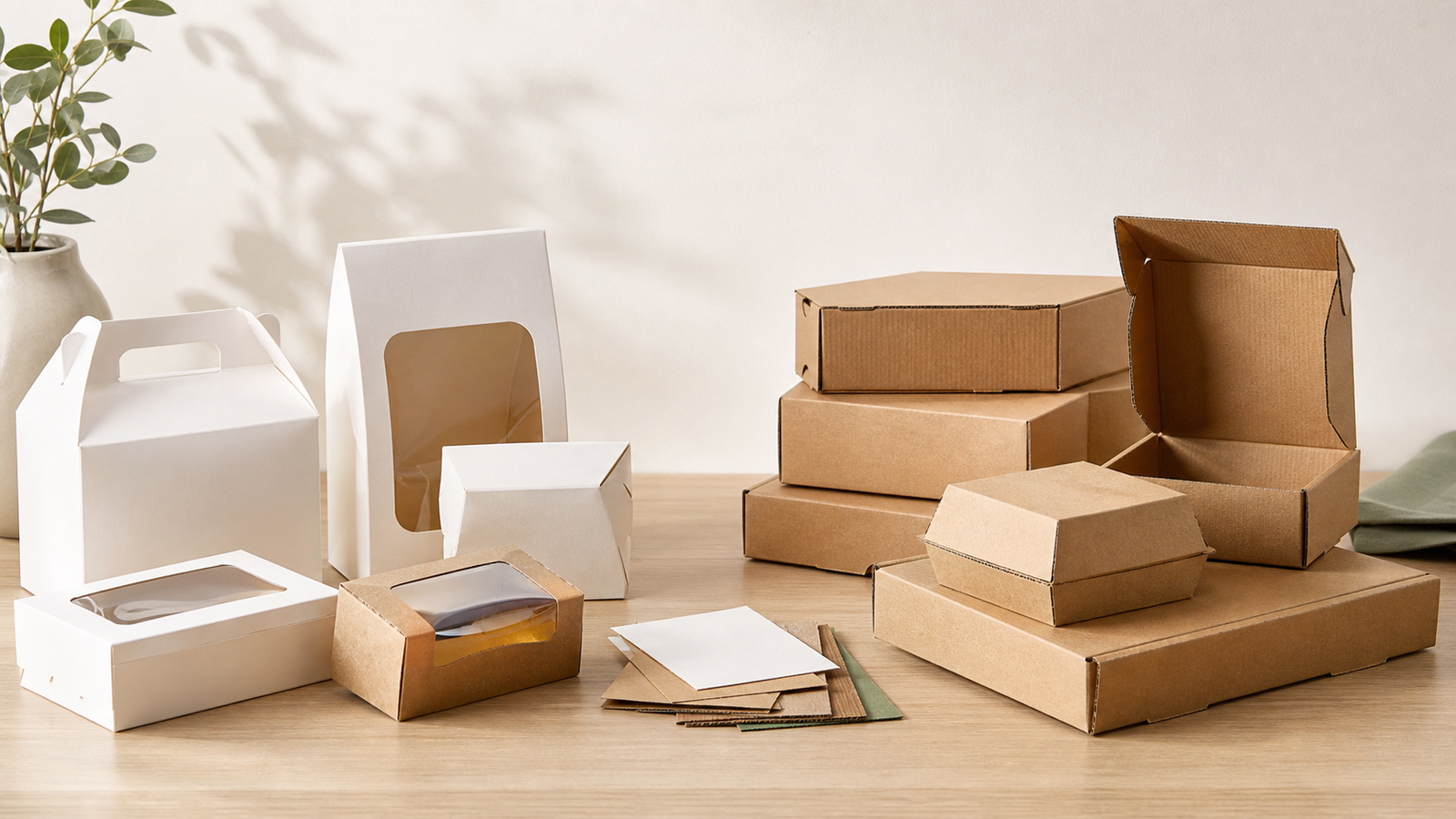
Paperboard and corrugated board are both widely used for food packaging, but they solve different problems. Paperboard is usually chosen for clean retail presentation and detailed printing. Corrugated board is selected when stiffness, stacking and delivery protection matter more. The correct choice depends on the food, box size, sales channel and journey after packing.
This guide helps food brands, bakeries and packaging buyers compare the two materials before requesting samples or quotations.
Quick comparison
- Choose paperboard for lightweight retail packs, premium graphics, compact storage and products that need a refined shelf appearance.
- Choose corrugated board for heavier products, larger packs, takeaway delivery, stacking or shipping.
- Use both when a printed inner carton needs a protective corrugated outer case.
What is paperboard packaging?
Paperboard is a solid sheet that is printed, cut, creased and folded into cartons. Common examples include cake boxes, pastry cartons, snack sleeves and small takeaway packs. Its smooth surface supports fine text, accurate brand colors and finishes such as embossing or foil.
Paperboard cartons normally arrive flat, which saves storage space. They also work well on retail shelves because panels stay visually clean and can include windows, locking tabs and inserts.
What is corrugated packaging?
Corrugated board contains a fluted paper layer between liners. The flute adds stiffness and cushioning without requiring one very thick solid sheet. It is used for pizza boxes, catering packs, food delivery boxes and shipping cases.
Corrugated grades differ by flute profile, liner quality and construction. Do not compare two boxes only by total thickness. A supplier should recommend the flute and paper combination for the required load and stacking conditions.
Compare strength and protection
Small paperboard cartons can be strong when the structure is engineered well, but large flat panels may bow under weight. Corrugated board usually performs better for heavy food, long delivery routes and vertical stacking.
Ask three practical questions: How heavy is the packed product? How many packs will be stacked? Will the box be carried by hand, transported locally or shipped in a larger case? Test samples under those real conditions.
Compare printing and brand presentation
Paperboard is often the easier choice for high-detail printing and premium retail finishes. Corrugated board can also be printed attractively, but the result depends on liner smoothness, flute profile and printing method. Fine artwork may need a coated liner or litho-laminated surface.
If exact color matters, request a printed proof on the actual material. Brown kraft surfaces make colors appear darker, while white liners give a brighter result.
Consider grease, moisture and food contact
Neither material name alone proves that a pack is suitable for direct food contact. The contact surface, barrier, ink, adhesive and intended temperature all matter. Fatty or moist foods may require grease-resistant paper, a liner, tray or appropriate coating.
For a full testing checklist, read our food-safe bakery packaging guide.
Compare storage and assembly
Folding cartons generally take less warehouse space. Corrugated boxes may also arrive flat, but thicker board increases storage volume. Assembly time matters in busy food service: a slightly more expensive self-locking design may save labor and reduce packing mistakes.
Compare total cost, not unit price alone
Material, box size, printing, tooling, packing speed, freight and damage rate all affect cost. A cheaper carton that collapses during delivery creates replacement and reputation costs. A stronger box may be unnecessary for a lightweight same-day retail product.
Ask suppliers to quote the complete specification and clearly state whether tooling, printing plates, inserts, packing and freight are included.
When a combined system is better
Many brands use a printed paperboard carton for product presentation and a corrugated master carton for transport. This separates the jobs: the inner pack communicates the brand, while the outer case handles stacking and shipping.
Sample test checklist
- Pack the real product at its normal temperature.
- Check usable internal dimensions and headroom.
- Carry and stack the expected quantity.
- Test grease, moisture and condensation.
- Inspect corners, locks, handles and windows after delivery.
- Time assembly with the staff who will use it.
- Confirm required food-contact documents for the destination market.
Final decision
Choose paperboard when presentation, detailed printing and compact storage lead the decision. Choose corrugated board when load, stacking and delivery protection are more important. If you need both presentation and protection, design the inner and outer packs as one system.
Review our packaging product gallery or send your product size, weight and delivery method for a practical material recommendation.